


-
Transferring the structure of a multilayer type to a multiline parameter
Icon


Related news and articles
- New plugin for Revit. Structure to parameter
- Revit. Structure to parameter: Reverse result and volume of layers to parameter
- Revit. Structure to parameter 3.0
Using
To start working with the plugin, you need to create a configuration by clicking
 . Created configurations can be duplicated
  , renamed
  , exported
  , imported
  and deleted
  using the corresponding buttons. The created configuration also applies to the command “Layer volumes to parameter” and contains settings for this command.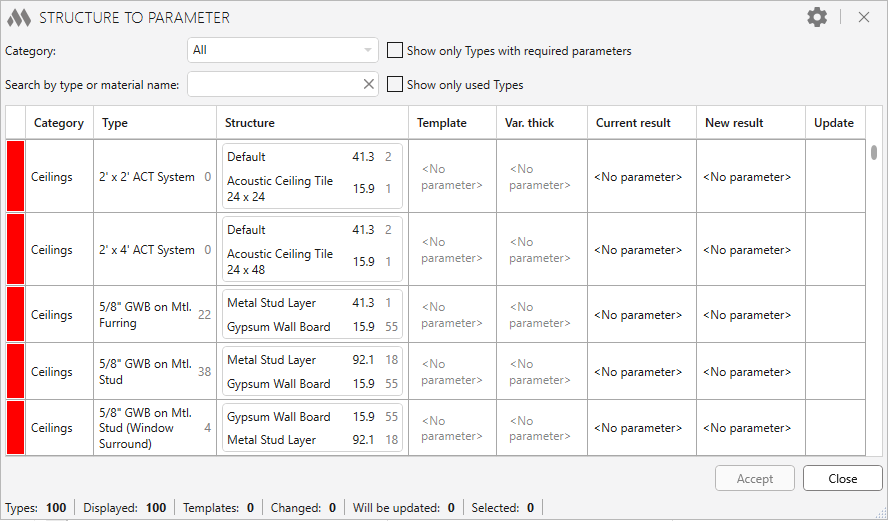
Next, you need to go to the settings window by clicking
.png) in the upper-right corner of the window and perform the initial plugin setup.
in the upper-right corner of the window and perform the initial plugin setup.SETTINGS

In the Parameters section, you must specify the following parameters:
- Template – a required type parameter with the “Multiline Text” data type. In this parameter, the user specifies the result generation template using structure placeholders (described below).
- Result – a required type parameter with the “Multiline Text” data type. The plugin will write the list of structure layers to this parameter, taking into account the defined row formats and numbering settings.
- Reverse result – an optional type parameter with the “Multiline Text” data type. The plugin will write the same list of structure layers as in the Result parameter, but in reverse order. The parameter is filled in if it exists for the processed type.
- Variable thickness – an optional type parameter with the “Text” data type. In this parameter, the user specifies the variable thickness value that will be used in the row format for a variable-thickness layer.
All parameters must be applied to the element categories for which layer structure information needs to be transferred into a parameter (for example, the “Roofs”, “Walls”, “Floors”, etc. categories).
The Structure placeholders used in the template section describes how to use placeholders that are specified in the Template parameter and replaced with a formatted list of structure layers in the Result parameter.
@ – a required placeholder used to replace with a formatted list of structure layers:

& – used to replace with a formatted list of merged structure layers:

[n] – used to specify the indices of layers that will be used to replace with a formatted list of structure layers. To specify multiple indices, list them separated by a dot or comma (for example, [1,5]):

^ – used to define a subheading for layers. It will not participate in the numbering of structure layers:

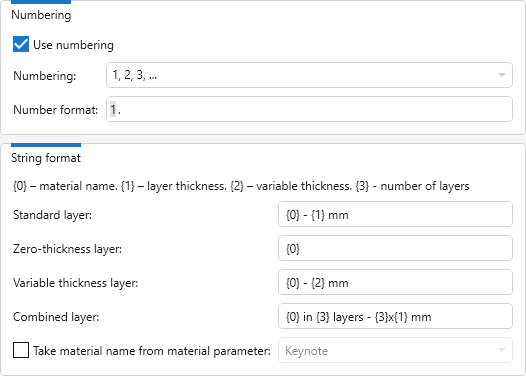
The Numbering section provides the following settings:
- Use numbering – when enabled, structure layers will be numbered according to the numbering settings.
- Numbering – a drop-down list with numbering options for structure layers.
- Number format – a character or group of characters that separates the layer sequence number from its description. For example, to make the line look like “1. Concrete…”, select the Numbering option 1, 2, 3, … and set a dot and a space in the Number format field.
The Row format section configures row templates containing information about structure layers that will be written to the Result parameter. The row format is defined for the following layer types:
- Standard layer – a layer made of a material with a constant non-zero thickness.
- Zero-thickness layer – a layer made of a material with zero thickness.
- Variable-thickness layer – a layer made of a material with variable thickness.
- Merged layer – a merged layer consisting of several material layers with constant non-zero thickness.
The row format template must use placeholder symbols: {0} - to insert the material name, {1} - to insert the layer thickness, {2} - to insert the variable thickness from the Variable thickness parameter, {3} - to insert the number of merged layers. For example, if you set “{0} - {1} mm” for a standard layer, the result will look like “Cast-in-place concrete - 175 mm”.
The Get material name from material parameter option allows you to specify a material parameter whose value will be used as the material name ({0}). When this option is enabled, the Structure column in the main plugin window displays the
.png) button for changing the value of the material parameter.
button for changing the value of the material parameter.MAIN WINDOW
The main plugin window consists of a table of types and their parameters, type filtering and search controls, as well as a status bar and control buttons at the bottom of the window.
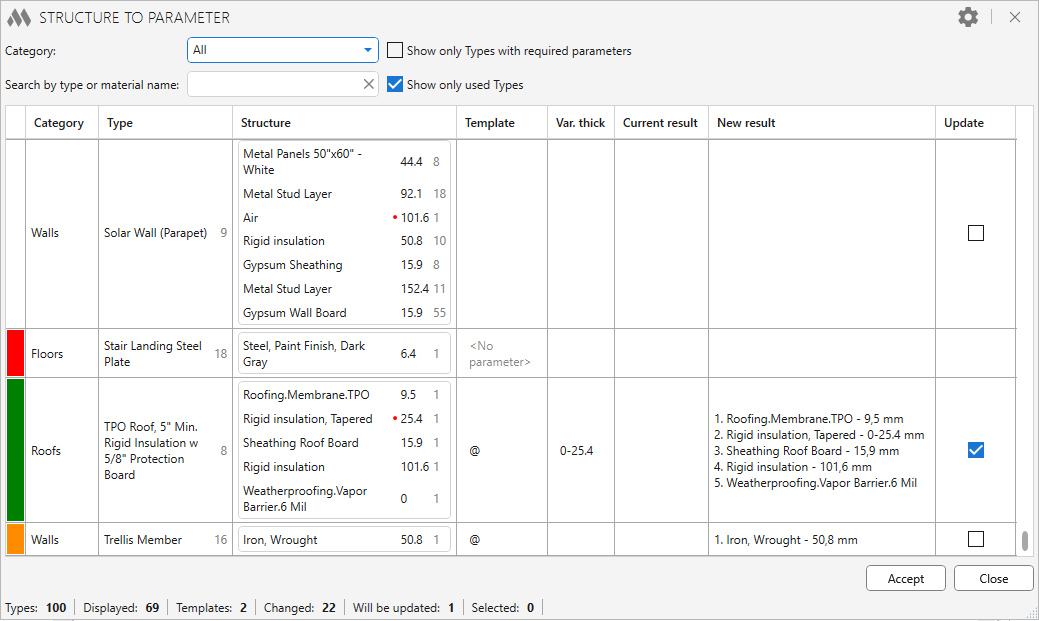
When the plugin starts, the table shows all types in the model for multilayer element categories (for example, the “Roofs”, “Walls”, “Floors”, etc. categories).
For convenience and faster processing of types, you can use the settings at the top of the plugin window:
- Category – a drop-down list where you can select one element category to display in the types table, or all categories at once.
- Search by type or material name – a field for quick case-insensitive search in the types table.
- Show only types with required parameters – when enabled, the table shows only types that contain the required Template and Result parameters.
- Show only used types – when enabled, the table shows only types that have at least one placed instance in the model.
- Show only modified types – when enabled, the table shows only types for which the new result differs from the current result and the Update column checkbox is not set.
The list of types and their parameters is presented as a table containing the following columns:
Category – the element category to which the type belongs.
Type – contains the type name and the number of instances in the model with this type.
Structure – the layer-by-layer structure of the type. Each row contains the following values:
- layer material
- layer function
- layer thickness (variable thickness is indicated by a red dot)
- the number of times the material is used in other types loaded into the plugin, including the current one. When you click (select) a row in the materials list, the rows containing this material in all types are highlighted in green.
Template – a required parameter. To output the list of structure layers to the Result parameter, the cell must contain the required structure placeholder @, and optional placeholders if needed. The field can be edited in the plugin window. You can also specify additional information in the template before and/or after the structure placeholder.
For example, a floor is defined by a floor type whose structure will be taken from the type, but you also need to specify the slab as part of the floor build-up. To do this, enter “RC slab” after the placeholder and you will get the following value:

Var. thick. – a user-defined variable thickness value that can be specified, if necessary, for a layer that has variable thickness. The field can be edited in the plugin window.
To quickly fill the Template or Var. thick. parameters with the same values, select multiple rows (using Ctrl or Shift) and enter the required value in the cell of any selected row, or paste it from the clipboard.
Current result – the value of the Result parameter at the moment the plugin starts.
New result – a list of structure layers taking into account the defined row formats and numbering settings, which will be written to the Result parameter after clicking Apply.
Update – an option to select types whose parameters should be updated with the layer structure. To mark multiple types, select the rows (using Ctrl or Shift) and check the box in any of the selected cells in this column. The option is available if the type contains both required parameters.
The contents of all columns (except the Structure column) can be sorted by clicking the column name.
To write the layer structure into the type parameters, the following conditions must be met:
- The type contains the required parameters specified in the plugin settings fields: Template and Result.
- The required structure placeholder @ is specified in the Template column.
- There are differences between the Current result and New result columns.
- The checkbox is set in the Update column.
To assess whether types meet the conditions above, the first cell of each row is highlighted with one of four colors:
- no color – no changes, the type parameters will not be updated
- red – the type is missing the required Template and Result parameters, or these parameters are not specified in the plugin settings
- orange – the new result differs from the current result, but the type parameters will not be updated because the checkbox in the Update column is not set
- green – the new result differs from the current result, and the type parameters will be updated because the checkbox in the Update column is set
When the first cells of the required types become green, click Apply to update the parameter values in the model. It is important to note that only visible green entries will be processed (for example, if a type in the “Walls” category was checked and then the “Floors” category filter was enabled, the “Walls” type will not be updated).
To close the plugin window, click Cancel or press Esc.
The status bar shows information about the number of types in the table that meet various conditions.
After clicking Apply, a results window appears:

LAYER VOLUMES TO PARAMETER


The command calculates layer volumes and writes them as a numbered list to a multiline instance parameter of the element, and also writes the total volume of layers of all instances to a multiline type parameter.
The command calculates layer volumes and writes them as a numbered list to a multiline instance parameter of the element, and the total volume of layers of all instances – to a multiline parameter of the corresponding type.
As with the main command, you first need to open the settings window by clicking
in the upper-right corner of the window and perform the initial setup.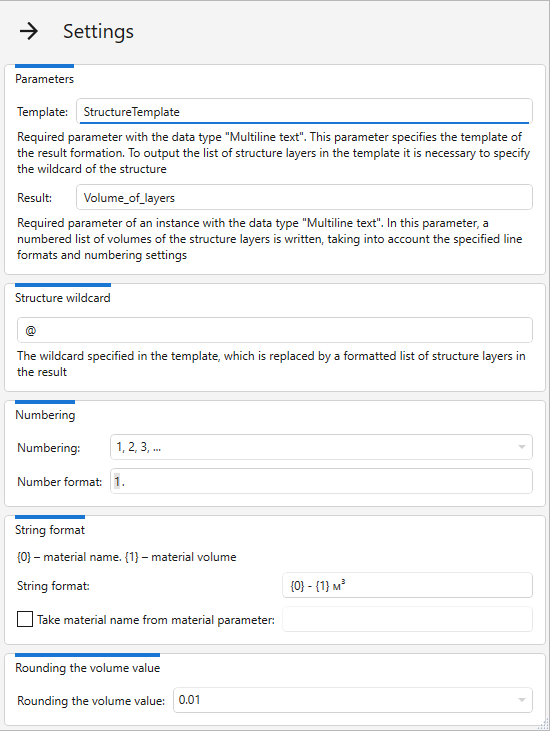
The settings are largely similar to the main command settings, but there are some differences.
Result for instances – an instance parameter with the “Multiline Text” data type. The plugin will write a numbered list of structure layer volumes to this parameter, taking into account the defined row formats and numbering settings.
Result for type – a type parameter with the “Multiline Text” data type. The plugin will write a numbered list of total structure layer volumes to this parameter, taking into account the defined row formats and numbering settings.
The parameters must be added to the element categories for which layer volume information needs to be written to parameters (for example, the “Roofs”, “Walls”, “Floors”, etc. categories).
Volume rounding – a drop-down list for selecting how to round the layer volume value.
The window for this command is also similar to the main plugin command:
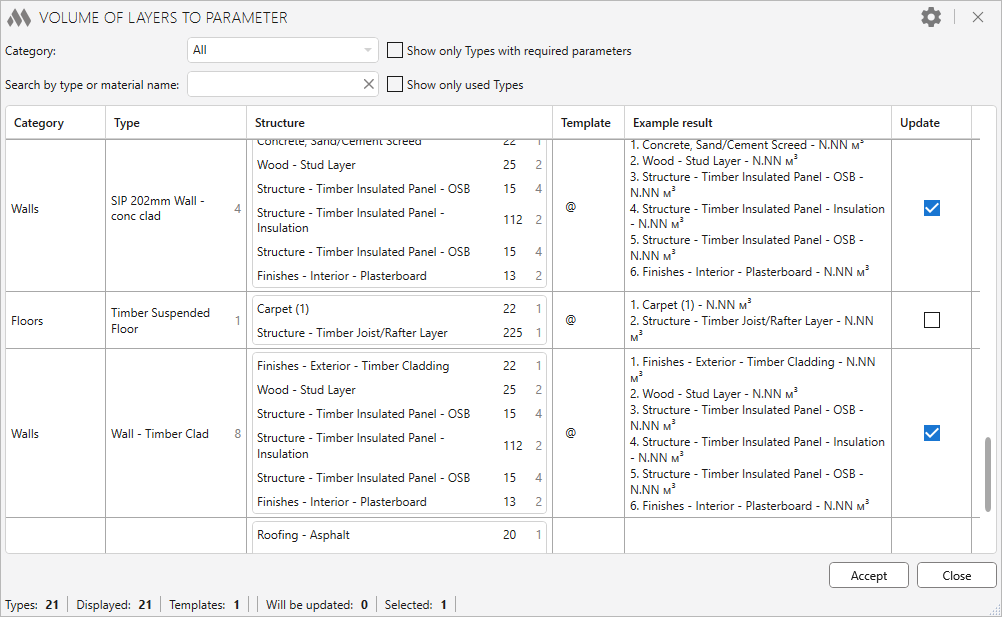
To write layer volumes to the instance and/or type parameter of an element, the following conditions must be met:
- There are placed instances of the type in the model.
- The type contains the required parameters Template and Result for instances and/or Result for type.
- The structure placeholder @ is specified in the Template column.
- The checkbox is set in the Update column.
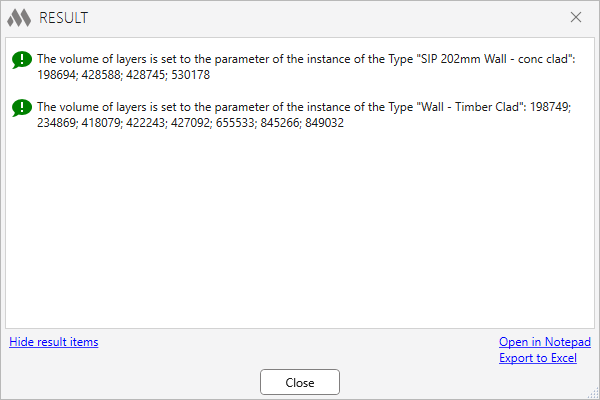
After clicking Apply, a results window appears:
-
-
Change history forYear
2026 Year
Revit: Structure to parameter 3.0.2.0 (20.03.2026)
FixFixed a bug in the parameter collection method.Revit: Structure to parameter 3.0.1.0 (19.03.2026)
ImprovedThe type loading algorithm has been optimized.Revit: Structure to parameter 3.0.0.0 (17.03.2026) Read more
NewAdded configurations.NewAdded drop-down lists for assigning parameters from available and matching data type options.NewAdded the ability to specify material layer types for writing to the structure.NewAdded the ability to enter text without numbering for the first line.NewAdded the ability to merge identical layers.NewAdded instance and type parameters for writing the result. The instance volume is written to the instance parameter, the total volume from all instances is written to the type parameter.NewAdded the ability to disable layer numbering.NewAdded the ability to display only structures that have been modified. Only for structure to parameter.NewAdded the ability to change the value of the selected material parameter when generating the structure.2023 Year
Revit: Structure to parameter 2.0.2.0 (04.12.2023)
FixImproved algorithm for rounding numbers.Revit: Structure to parameter 2.0.1.0 (04.12.2023)
ImprovedService update.Revit: Structure to parameter 2.0.0.0 (04.12.2023) Read more
NewAdded possibility to write a reversed result.NewAdded new command - Volume of layers to the parameter.Revit: Structure to parameter 1.1.2.0 (08.11.2023)
ImprovedUsing the ModPlus.Xaml.Behaviors.Wpf.dll library instead of Microsoft.Xaml.Behaviors.dll to resolve compatibility issues with other plugins.Revit: Structure to parameter 1.1.1.0 (13.07.2023)
FixFixed a bug that caused material names not to be displayed in the layer list.Revit: Structure to parameter 1.1.0.0 (12.07.2023)
NewAdded the ability to specify the material parameter from which the material name will be taken.Revit: Structure to parameter 1.0.0.0 (12.07.2023) Read more
ReleaseRelease. -